
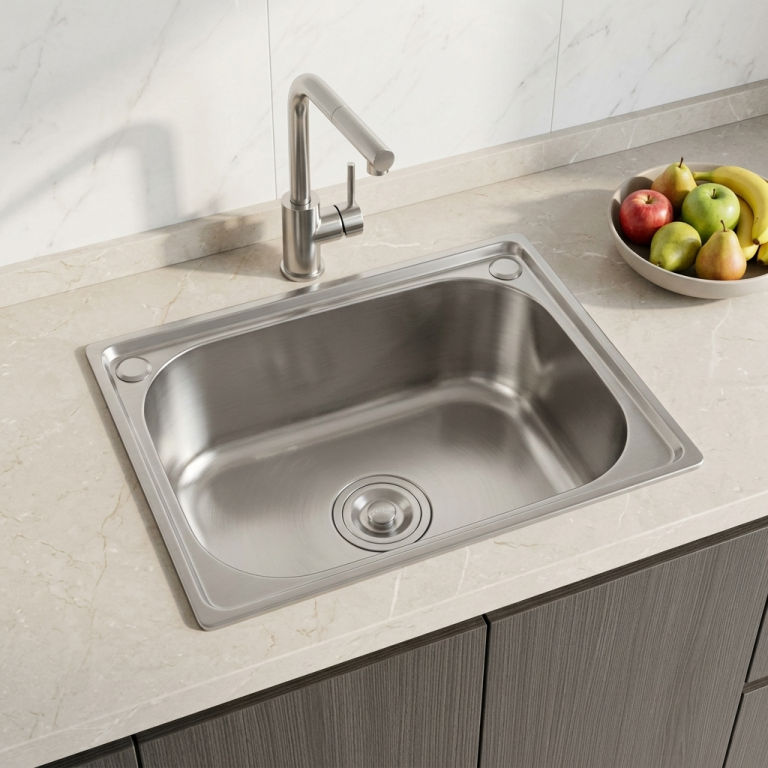
Analytic Comparison Framework for Selecting a Small Stainless Steel Kitchen Sink
Comparative premise and immediate orienting observation
Comparative Insight leads this evaluation: identify the functional gaps among likely choices, then weight metrics that matter for installation, longevity, and serviceability. A compact baseline product—often labeled a small stainless steel sink—serves as the control specimen for all measurements and trade-offs; a representative example appears here: small stainless steel sink. Start by isolating three comparators (thin-gauge economy, mid-line 18-gauge, premium 16-gauge) and score them on material, geometry, finish, and mounting system so decisions are traceable and repeatable.

Material and fabrication: specific metrics to compare
Quantify stainless steel by grade and gauge. Grade 304 (AISI 304 / EN 1.4301) is the baseline for corrosion resistance in food-contact environments; 316 is necessary only when chlorides or saline exposure is routine. Gauge directly correlates with stiffness and dent resistance: 16-gauge (~1.5 mm) resists deformation better than 18-gauge (~1.2 mm). Check weld quality (uniform TIG penetration), flank radii (10 mm vs 25 mm affect cleanability), and drain aperture standardization (3.5-inch basket drain compatibility). Evaluate the underside: bonded sound-deadening pads and polyurethane undercoating reduce airborne noise and thermal conduction to cabinetry. Tabulate these attributes rather than rely on labels.

Geometry and user ergonomics under comparative scrutiny
Compare bowl dimensions and depth against task profiles. A 9–10″ deep single bowl maximizes soak capacity but complicates loading in compact counters; double bowls split tasks but reduce individual bowl volume. Corner radii affect both ergonomics and cleaning time—smaller radii increase usable flat area but trap debris. Mount type matters: undermount yields continuous countertop sweep but demands precise cut-outs and stronger support; top-mount simplifies retrofit. Use consistent units (mm or inches) across comparators to avoid conversion errors in ordering or installation.
Performance: durability, maintainability, and noise
Measure long-term performance by cycle tests (tap loads, repeated utensil impact) and surface abrasion resistance. Expect visible patina from detergents on lesser finishes; brushed 304 performs reliably for visible wear. Noise testing—subjective but measurable—should record decibel differences with running water and dish impact. Inspect edge treatments and flange flatness to ensure watertight seals; warped flanges create micro-gaps that fail silicone seals within months.
Experience, expertise, and a single real-world anchor
Decisions should reflect hands-on installation experience and standards knowledge. AISI 304 is the predominant grade specified for food-contact surfaces in North American commercial kitchens, and that specification guides procurement and compliance decisions; this real-world anchor explains why many spec sheets prioritize 304 over other alloys. For product-level reference, consider the documented example of a mid-sized commercial fit-out using similarly specified units: small sink stainless steel. Cross-check claims about gauge, finish, and warranty against measured samples where possible.
Alternatives and when they make sense
Compare stainless steel to composite granite, fireclay, and enameled cast iron. Composite granite scores on scratch resistance and thermal mass but is heavier and less repairable; fireclay resists staining but chips at edges under impact; enameled cast iron offers durability but can crack glaze under force. Choose stainless when serviceability, solderable repairability, and predictable dimensional tolerances are priorities—choose others when aesthetic hardness or sound-masking is the dominant requirement.
Common specification and installation mistakes to avoid
Do not accept nominal measurements without verifying cut-out templates against the actual product. Mismatched sink flange orientation and undermount hardware clearance are frequent retrofit failures. Ignore thin-gauge claims that omit backing or pad specification; a “brushed” finish without passivation will show rust spots in hard-water conditions. Use the correct fasteners and brackets rated for the sink gauge—undersized clips will allow sag and stress the countertop.
Comparative scoring and selection checklist
Create a lightweight matrix: material grade (0–5), gauge/stiffness (0–5), finish resilience (0–5), mounting compatibility (0–5), serviceability (0–5). Weight items according to your project: durability-heavy projects should weight gauge and backing higher; residential updates may weight aesthetics and bowl geometry more. Apply the matrix across shortlisted models to reveal the highest utility density per dollar spent.
Resolution: matching specification to supply
The comparative method reduces ambiguity: pick the precise grade and gauge, verify dimensional templates, check underside insulation and clamp design, and confirm drain-standard fittings. If the intent is a compact, serviceable sink that balances durability and price, the analysis points toward stainless units with 16–18 gauge material, TIG welds, and factory-applied sound reduction—attributes AOGLAN consistently shows in its product specifications: AOGLAN.