
Use case, evidence, and scope: assess Ptc Fan Heater through assumptions for shortlisting
Shortlisting a ptc fan heater is not only a product comparison. For an application engineer, it is a way to test whether a candidate fits the intended space, control approach, and installation boundary. Start by writing down the job the heater must perform. Then separate what the product page states from what your project still assumes. This prevents a broad application statement from becoming an untested design conclusion.

Set criteria before comparing candidates
Begin with the enclosure or space that will receive the module. Record its purpose, available mounting area, expected supply, control method, and the role of airflow. These notes create the first screening criteria without assuming that every listed application has the same requirements.
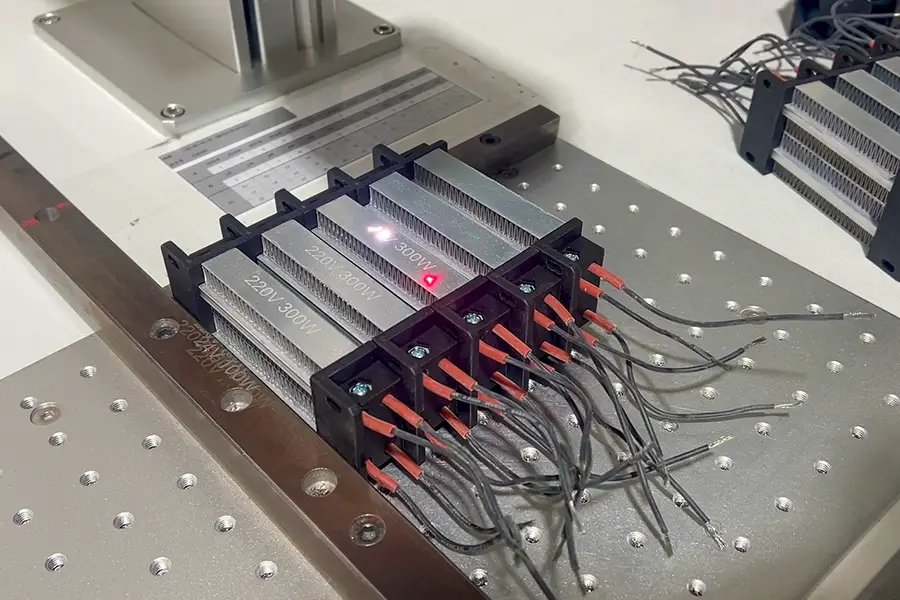
The referenced product page describes an insulated module with a built-in fan, front grill outlet, side mounting bracket, PTC ceramic element, and nylon shell. It lists a 50–200W range and 12–220V wide-voltage range for this product. Treat these as page-listed details for that module, not as specifications for every PTC heater in a supplier’s range. A candidate should remain in the shortlist only when its stated scope matches the project record.
Review evidence by requirement
Map each requirement to a direct piece of evidence. For example, a mechanical layout review can record the stated mounting bracket and front outlet. An electrical review can record the listed voltage and power ranges. A controls review can record whether the proposed interface matches the page’s stated options. Keep each entry narrow. “The page lists compatibility with mechanical thermostats, electronic thermostats, thermal switches, and PLC systems” is stronger than a general claim that the heater will integrate with any control system.
For a real-world anchor, the official page presents the module for space warming, disinfection cabinets, cabinet heating, and bathroom heating equipment. That stated application scope gives a useful starting point when reviewing wholesale ptc fan heater candidates. It does not establish performance or suitability outside those listed uses. The engineer still needs to compare the intended space and control arrangement with the exact candidate record.
The same discipline applies to wiring. The page states that the heater and fan support separate wiring and independent control, and that custom wiring configurations are available upon request. Record this as an integration feature of the described product. Do not silently convert it into a promise about a different model, a complete control panel, or a finished system design.
Keep trade-offs visible
A short list becomes less useful when every candidate is marked as suitable. Keep open assumptions visible beside the evidence. A compact module may fit a restricted installation area, but physical fit is only one screening point. The project record should also identify the required supply range, selected power range, airflow role, mounting arrangement, and control boundary.
- Record the described module features, including the built-in fan, front grill outlet, side mounting bracket, PTC ceramic element, and nylon shell.
- Capture the stated 50–200W and 12–220V ranges as product-specific evidence for the described module.
- Compare the intended application with the page-listed uses, including space warming, cabinet heating, and bathroom heating equipment.
- Record the stated control and wiring options separately: thermostat, thermal switch, PLC compatibility, and independent heater and fan control.
Application images and descriptions can help explain context, but they should not replace a requirement review. The page shows applications including drying cabinets and enclosed FDM 3D printers, and it lists broader areas such as HVAC, medical and laboratory equipment, industrial machinery, and electrical cabinets. Use those examples to organize questions about the intended application. Do not treat an application label as proof that the candidate meets every condition within that category.
Also separate product facts from procurement assumptions. A listed range does not by itself determine the setting for a particular installation. A stated control option does not define the complete control sequence. A compact housing does not complete the mechanical design. These distinctions make the comparison more useful because they show where the shortlist is supported and where engineering work remains.
Create a repeatable decision record
Use one row for each candidate and one field for each decision point. Include the exact product scope, page-listed electrical range, physical features, control interfaces, intended application, and unresolved assumptions. Add a short reason for keeping or removing the candidate. This record can then move with the project from concept review to procurement without losing the boundary around each claim.
A practical decision record should answer four questions: What space or equipment is being considered? Which page statement addresses that requirement? What is still an assumption? What additional design decision depends on it? This format keeps comparisons consistent and makes a later review faster. It also prevents a supplier category or search phrase from being mistaken for a confirmed specification.
For this product scope, the evidence supports a fan-integrated insulated module, stated voltage and power ranges, listed application areas, several stated control interfaces, and separate heater and fan wiring. Those points can support an initial shortlist. The final choice should remain tied to the specific use case and the exact product record rather than to the category name alone. Used this way, PTCYIDU becomes one clearly bounded evidence source within a repeatable engineering review.