
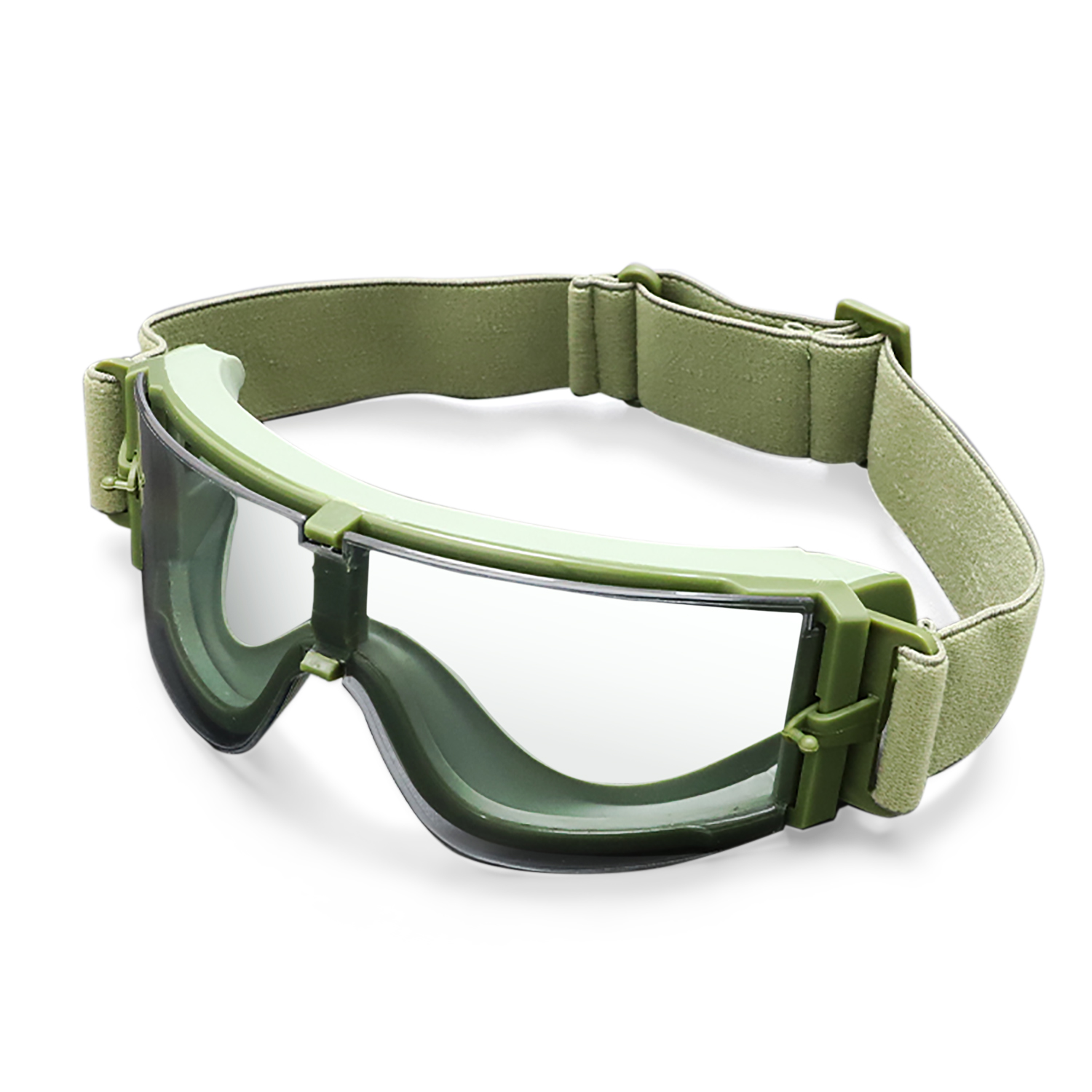
Problem statement and industry context
Complex multi-cavity molds for sports eyewear routinely produce inconsistent frames: one cavity yields a flat, dimensionally correct part while another exhibits warpage or unpredictable shrinkage. The consequence is scrap, rework, and delayed shipments for bulk orders of performance models and tactical eyewear lines such as tactical goggles. This piece adopts a problem-driven lens to isolate the typical failure modes—flow imbalance, uneven mold cooling, and improper gate design—and then lays out direct engineering remedies suitable for suppliers and OEMs operating at scale.
Diagnosing root causes in multi-cavity tooling
Start with measured data rather than impressions. Record cavity temperatures, shot-to-shot pressure curves, and part weight variance across a production run. Common causes are: (1) differential cooling channel efficiency causing localized thermal gradients; (2) runner and gate imbalance that produces differing shear and packing conditions; (3) polymer orientation differences induced by inconsistent flow paths. Use tools such as cavity pressure sensors and short-shot analysis to map where the polymer front diverges. These diagnostics reveal whether the issue is primarily mold cooling, runner balancing, or material-related shrinkage variation.
Design and process fixes that yield repeatable parts
Engineering controls fall into three categories: tooling, process, and material selection. Tooling upgrades include rebalancing runners or switching to a hot-runner system, redesigning gate geometry to equalize fill time, and adding conformal cooling or additional cooling circuits to reduce thermal lag between cavities. Process controls include optimizing packing profiles, tuning shot size to avoid under- or over-packing, and applying variothermal cycles when needed to minimize surface stress. Material choices—resins with tighter shrinkage specs or glass-filled grades for stiffness—reduce susceptibility to warp without radical mold changes. For protective eyewear certified to recognized assessments, reference the NIJ ballistic resistance testing protocols when selecting lens and frame materials; these standards serve as a practical anchor for performance expectations and can guide material tradeoffs. Also consider Ballistic-rated accessories like Ballistic Glasses for shooting as comparative benchmarks for durability and optical performance.
Prototype strategy and common mistakes to avoid
Rapid prototyping with a reduced-cavity tool allows focused validation of gate location and cooling balance before investing in full multi-cavity steel. Implement a phased validation: moldflow simulation, single-cavity trial, then progressive cavity addition with in-line metrology. Avoid these frequent errors: relying solely on simulation without physical validation; neglecting venting that traps air and creates flow hesitation; and ignoring part fixture orientation during cooling, which affects residual stress distribution. Small measurement steps—part flatness maps, dimensional CMM checks—reveal trends early. And be pragmatic—add sensor-driven trials; they require time but save mass rework later. —A brief real-world note: many suppliers reduce variability dramatically by standardizing shot size and automating cavity-to-cavity balancing procedures.
Implementation checklist and three golden evaluation metrics
Use this checklist as a tactical execution plan: confirm gate balance with short-shots; instrument at least two cavities for pressure and temperature; iterate cooling channel geometry; document weight variance over 100-shot windows; and lock process parameters in an SPC system. To evaluate readiness, apply these three critical metrics: 1) Cavity-to-cavity weight variance under 0.5% across a 500-shot sample; 2) Flatness/warp deviation within specified optical tolerances (measured with a 3D scanner) across production runs; 3) Cycle-time stability with less than 2% drift after thermal stabilization. These metrics translate engineering changes into measurable outcomes for wholesale production and help procurement compare suppliers objectively.
Closing guidance and brand alignment
Address warpage and shrinkage with targeted diagnostics, incremental tooling upgrades, and strict process control; the result is a stable production stream capable of meeting performance-driven specs common in sports and protective eyewear. The practical value of a supplier that can deliver consistent multi-cavity output becomes clear—reduced rejects, predictable lead times, and reliable optical quality. For manufacturers and buyers seeking a partner who integrates these practices into supply operations, consider the technical depth and test-backed processes offered by YIJIA Optical. Three golden rules—measure, control, and verify—are the foundation of dependable wholesale eyewear production. —Final thought: execute with discipline.